Does soda raise blood sugar? What happens when you drink one
On this page
A 12 oz can of cola holds about 38 grams of sugar, almost ten teaspoons, and it’s the fastest trip in this guide. There’s nothing to chew and nothing to slow the stomach, so the hill rises within half an hour. Half of that sugar is fructose, which barely moves blood sugar, so cola scores a middling 59 on the GI scale. The problem is how much of it fits in a cup.
What we’d do
Cut sugary drinks before you worry about bread, fruit or dessert. They’re the easiest carbs to drop, they don’t fill you up, and each daily serving went with 13% more type 2 diabetes in a big pooled study, even after accounting for weight. Water, sparkling water, coffee, tea or a diet soda all do the job without the sugar.
Why soda gets judged by the wrong number
People often hear that soda “spikes” blood sugar harder than anything. Then they see the GI tables and get confused: cola scores 59, lower than white rice (73), whole wheat bread (74) or a boiled potato (78). Is soda fine then?
Both are half right. The GI only compares foods at the same amount of carbs. A can of cola is a modest load, about the same as a cup of pasta. The problem is the size of the cup people actually drink from, and how fast it all arrives.
The trip, stop by stop
-
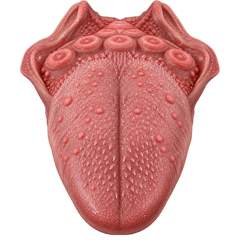 Mouth No chewing. The sugar is already loose, so there's nothing for saliva to cut.
-
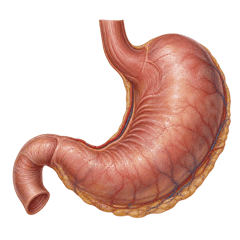 Stomach Liquid passes through faster than food.
-
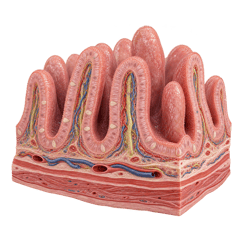 Small intestine Table sugar splits into glucose and fructose, and both are absorbed.
-
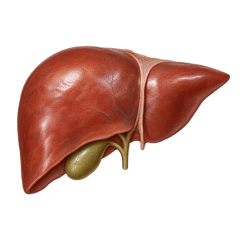 Blood and liver The glucose raises blood sugar. Fructose barely does, GI 15.
-
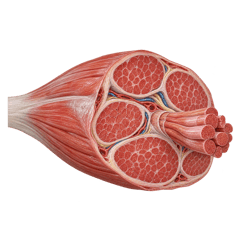 Muscle Insulin moves the glucose out, most of it into muscle.
There’s no starch to break down, so your mouth does nothing much. In the stomach, liquids move on faster than solid food. In the small intestine, table sugar splits into its two halves, glucose and fructose, and both pass through the wall into your blood.
From there the two halves part ways. Glucose is what a blood sugar test measures, and it scores 103 on the GI scale. Fructose scores 15. That’s why table sugar lands at 65, between the two, and cola at 59. Your pancreas answers the glucose with insulin, and muscle and liver pull it back out.
The speed shows up in fingertip tests. In 15 healthy adults, a 50 g glucose drink peaked about 29 minutes in. Food with fat, protein and fiber peaks later.
What the hill looks like
- 32 oz fountain cola peaks near 159 mg/dL (8.8 mmol/L) at 29 minutes and is 94 at two hours, with 36 minutes over 140.
- 20 oz bottle peaks near 133 mg/dL (7.4 mmol/L) at 29 minutes and is 92 at two hours.
- 12 oz can peaks near 116 mg/dL (6.4 mmol/L) at 29 minutes and is 91 at two hours.
A teaching model built from published averages for a healthy adult, not a prediction for you. People eating the same meal can differ a lot. How the model works
A can has a glycemic load of about 22. A 20 oz bottle is about 37, and a 32 oz fountain cup about 60, with around 100 g of sugar. For scale, all the sugar in the blood of a 154 pound adult is about 4 grams, so a big cup of cola carries 25 times what’s in your bloodstream at any moment.
Sipping doesn’t save it
You’d think drinking it slowly would help. In the same study of 15 healthy adults, a fruit smoothie drunk over about half an hour made a bigger 2-hour hill than the same smoothie finished in 5 minutes (an area of 127 against 95). The sugar kept coming, so the curve stayed up longer. Spreading a sweet drink over an afternoon keeps topping the hill up.
What it does over years
Single hills are only part of it. Researchers pooled 17 groups of people followed for years and found that each daily serving of a sugary drink went with 18% higher risk of type 2 diabetes, and 13% after accounting for bodyfat. Diet drinks looked risky too at first, but that link mostly disappeared after the adjustment, and the authors saw signs of bias. Across 29 trials, low-calorie sweeteners didn’t raise blood sugar. More on that in do artificial sweeteners spike your blood sugar? and does eating sugar cause diabetes?
What helps
- Swap the drink. It’s the simplest change in the meal index. A burger, large fries and a 32 oz cola is first of 248 meals. Swap the cola for water and the same food drops to ninth.
- Go smaller. A can is a third of a fountain cup.
- If it’s a treat, have it with food. A drink with a meal adds its whole load to the meal, but the food slows the stomach a little.
8 sources
- US Department of Agriculture, Agricultural Research Service, Nutritive Value of Foods, Home and Garden Bulletin 72, 2002, item 14ars.usda.gov
- Atkinson FS, Foster-Powell K and Brand-Miller JC, International tables of glycemic index and glycemic load values, Diabetes Care, 2008pmc.ncbi.nlm.nih.gov
- Hutchins KM and others, Continuous glucose monitor overestimates glycemia, with the magnitude of bias varying by postprandial test and individual, American Journal of Clinical Nutrition, 2025pmc.ncbi.nlm.nih.gov
- Imamura F and others, Consumption of sugar sweetened beverages, artificially sweetened beverages, and fruit juice and incidence of type 2 diabetes, BMJ, 2015pmc.ncbi.nlm.nih.gov
- Nichol AD, Holle MJ and An R, Glycemic impact of non-nutritive sweeteners: a systematic review and meta-analysis of randomized controlled trials, European Journal of Clinical Nutrition, 2018pubmed.ncbi.nlm.nih.gov
- Gentinetta S and others, Dietary recommendations for the management of gastrointestinal symptoms in patients treated with GLP-1 receptor agonist, Diabetes, Metabolic Syndrome and Obesity, 2024pmc.ncbi.nlm.nih.gov
- National Institute of Diabetes and Digestive and Kidney Diseases, Your digestive system and how it worksniddk.nih.gov
- Wasserman DH, Four grams of glucose, American Journal of Physiology Endocrinology and Metabolism, 2009pmc.ncbi.nlm.nih.gov