Does broccoli raise blood sugar? What happens when you eat it
On this page
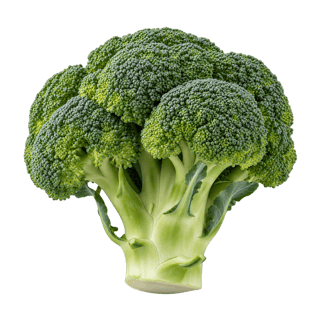
Almost nothing. A cup of cooked broccoli has 8 grams of carbohydrate, and 4.5 of those are fiber you don’t digest, which leaves about 3.5 grams that can reach your blood. That’s less than a teaspoon of sugar spread over an hour or two. Broccoli has no GI at all, because nobody can eat enough of it for a test.
What we’d do
Fill half the plate with vegetables like broccoli, and eat them first. They add almost nothing to the hill themselves, and eaten before the rice or bread, they make the carbs that follow come in slower.
Why vegetables get lumped in with “carbs”
Nutrition labels count broccoli as a carbohydrate food, and some apps put it in the same bucket as bread. On a label, a cup of broccoli shows 8 grams of carbs, which looks like a third of a slice of bread.
But most of that is fiber. The USDA lists 4.5 g of fiber in a cooked cup, so the carbs your gut can actually turn into glucose come to about 3.5 g. A slice of white bread has about 11.
The trip, stop by stop
-
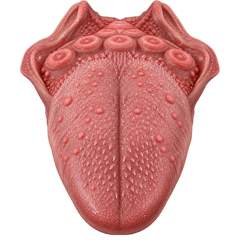 Mouth Lots of chewing for very little sugar.
-
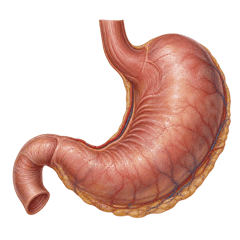 Stomach Fiber and bulk fill it up and help it empty slower.
-
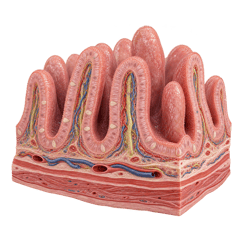 Small intestine About 3.5 g of sugars get absorbed. The fiber moves on.
-
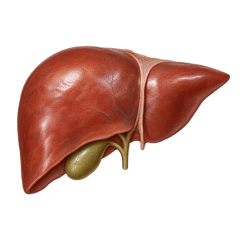 Blood and liver The liver takes its share and blood sugar barely moves.
-
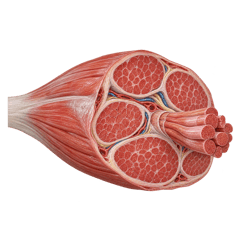 Muscle Nothing much to do.
Broccoli goes the same way as everything else, but carries very little. You chew it, your stomach mixes it, and your small intestine absorbs the few grams of sugar in it. The fiber can’t be broken down by your own enzymes, so it carries on through the gut without becoming blood sugar.
The University of Sydney group that runs the international GI database explains why broccoli has no number: foods like this contain “no carbohydrate, or so little that their GI cannot be tested according to the standard methodology.” The glucose drink in the fingertip study on this site held 50 g of carbs. To get 50 g of digestible carbs from broccoli you’d need about 14 cups.
What the hill looks like
- Cup of white rice peaks near 117 mg/dL (6.5 mmol/L) at 40 minutes and is 96 at two hours.
- Rice plate, vegetables first peaks near 109 mg/dL (6.1 mmol/L) at 51 minutes and is 98 at two hours.
- Cup of broccoli stays flat, near 90 mg/dL.
A teaching model built from published averages for a healthy adult, not a prediction for you. People eating the same meal can differ a lot. How the model works
On its own, broccoli is a flat line. The interesting part is what it does next to starch.
Vegetables first
In a 2019 study, 15 adults with prediabetes ate the same meal three ways: carbs first, then protein and vegetables, or protein and vegetables first with the carbs 10 minutes later, or everything together. Eating the carbs last cut the peak by more than 40% and the area under the curve by 38.8%, compared with carbs first.
Part of the reason is the stomach. Fiber, protein and fat all change how fast the stomach empties, so a stomach that’s already full of broccoli and chicken lets the rice out more slowly.
What helps
- Half the plate. Broccoli, green beans, salad, peppers, cauliflower and zucchini all barely register, and they make room for less starch.
- Eat them first. Same food, different order, a smaller hill. See rice first or protein first?
- Don’t count them as carbs to cut. If you’re watching your numbers, the vegetables aren’t the problem. The rice, bread and drinks next to them are.
What about the carbs in broccoli on a label?
If you count carbs, count the digestible ones. In the USDA’s tables, broccoli’s 8 grams of carbohydrate include 4.5 grams of fiber. Take the fiber away and they become about 3.5. The same goes for most green vegetables, which is why they sit at the very bottom of the meal index whatever their label says.
The surprising part
Vegetables aren’t all the same. Starchy ones act more like bread: a boiled potato scores 78, sweet potato 63 and sweet corn 52. Carrots score 39, but a cup has only about 11 g of digestible carbs, so their hill is small. Green vegetables like broccoli don’t get a GI at all.
8 sources
- US Department of Agriculture, Agricultural Research Service, Nutritive Value of Foods, Home and Garden Bulletin 72, 2002, items 636 and 1067ars.usda.gov
- University of Sydney, Glycemic Index FAQsglycemicindex.com
- Hutchins KM and others, Continuous glucose monitor overestimates glycemia, with the magnitude of bias varying by postprandial test and individual, American Journal of Clinical Nutrition, 2025pmc.ncbi.nlm.nih.gov
- Shukla AP and others, The impact of food order on postprandial glycaemic excursions in prediabetes, Diabetes, Obesity and Metabolism, 2019pubmed.ncbi.nlm.nih.gov
- Gentinetta S and others, Dietary recommendations for the management of gastrointestinal symptoms in patients treated with GLP-1 receptor agonist, Diabetes, Metabolic Syndrome and Obesity, 2024pmc.ncbi.nlm.nih.gov
- Harvard T.H. Chan School of Public Health, The Nutrition Source, Added sugar in the dietnutritionsource.hsph.harvard.edu
- Atkinson FS, Foster-Powell K and Brand-Miller JC, International tables of glycemic index and glycemic load values, Diabetes Care, 2008pmc.ncbi.nlm.nih.gov
- National Institute of Diabetes and Digestive and Kidney Diseases, Your digestive system and how it worksniddk.nih.gov