How to measure it: lab, finger stick, sensor or home kit
On this page
- Should you buy a sensor before a lab test?
- What can each test tell you?
- Why does a sensor run higher than a finger stick?
- What does a healthy day look like on a sensor?
- Why is my sensor’s GMI higher than my A1c?
- Does wearing a sensor help if you don’t have diabetes?
- How do you check a meal with a finger stick?
Start with a lab A1c and a fasting glucose, because only a lab test decides where you stand. A finger-stick meter is cheap and checks single meals. A sensor shows the shape of your day, but it measures the fluid under your skin about 5 minutes behind your blood, and in healthy adults one ran about 16 mg/dL high. A home A1c kit can’t diagnose anything.
What we’d do
Get the lab tests first. If you’re curious after that, use a finger-stick meter for a couple of weeks, checking 2 hours after the meals you wonder about. Going straight to a sensor is like learning to drive in a Ferrari. It’s expensive, and you skip the basics. If you do wear one, wear it for two weeks with a purpose, comparing your own meals with each other, and ignore the score it gives your day. Never let a sensor talk you into or out of a lab test.
If you remember three things
- Only a lab test can put you in a band. A meter, a sensor and a home kit can’t.
- A sensor runs high. Take 5 to 27 mg/dL off for a likely fingertip number.
- The 70% time in range on sensor reports is a goal for people with diabetes. Healthy people sit at 87 to 96% between 70 and 140.
Should you buy a sensor before a lab test?
Sensors are easier to get than ever. Dexcom’s Stelo became the first over-the-counter sensor in the US on March 5, 2024, cleared for adults 18 and over who don’t use insulin, with sensors worn for up to 15 days. So a lot of people now start with a sensor, and never get the two lab numbers that decide their risk.
That order is backwards. A sensor tells you how your meals look. It can’t tell you if you have prediabetes, and the FDA’s own announcement says users shouldn’t make medical decisions from it without talking to their doctor. A fasting glucose and an A1c from a lab can.
What can each test tell you?
| Test | What it measures | Can it diagnose? | Best for |
|---|---|---|---|
| Lab fasting glucose | Blood sugar after 8 hours or more with no food, from a vein | Yes, with a second abnormal result | Where you stand |
| Lab A1c | Sugar stuck to your red cells, about 3 months’ average | Yes, from a certified lab, with a second abnormal result | Where you stand, and your 12-week retest |
| Lab 2-hour test | Blood sugar 2 hours after a 75 g glucose drink | Yes, with a second abnormal result | Catching people the other two miss |
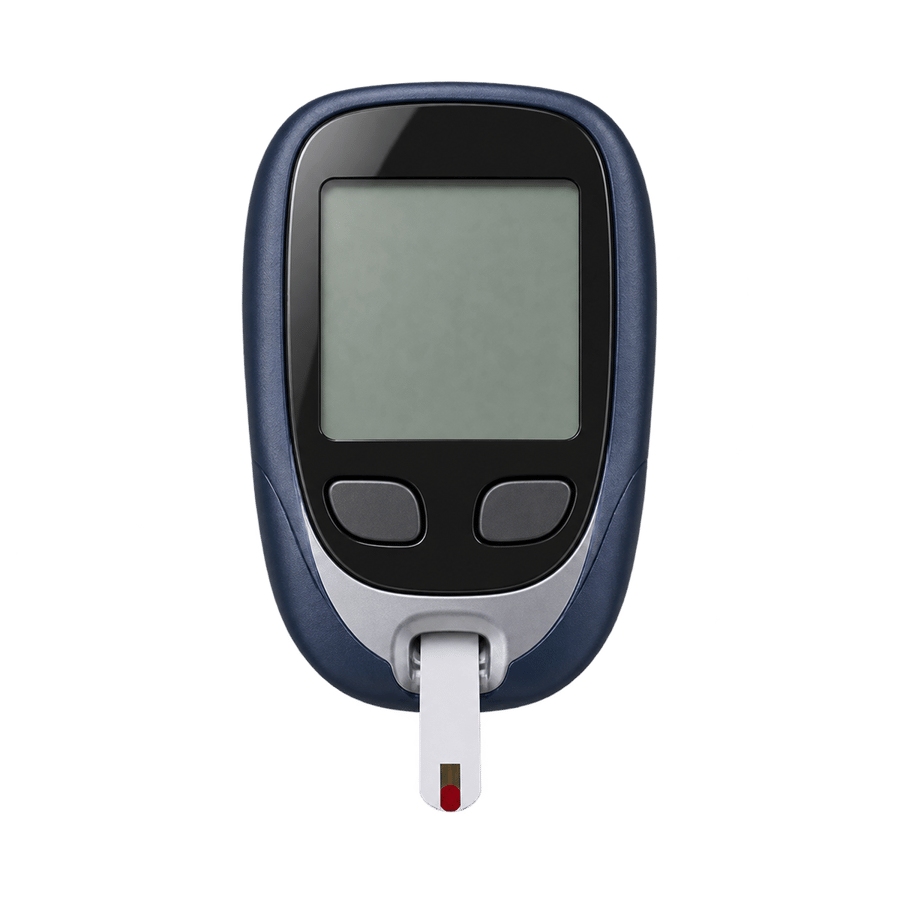
| Finger-stick meter | One drop of fingertip blood, right now | No | Checking a meal at 2 hours, checking a low |
| Sensor (CGM) | Sugar in the fluid under your skin, every few minutes | No | The shape of your day, comparing your own meals |
| Home A1c kit | A finger-prick A1c | No | Not much, beside a lab test |
The ADA’s 2026 standards ask for an A1c run by a method certified to the national standard (NGSP), and two abnormal results before a diagnosis unless the number is clearly high. That’s why home kits and meters can flag something but can’t decide it.
Why does a sensor run higher than a finger stick?
A sensor’s thin filament sits in the fluid between cells under your skin, not in a blood vessel. Sugar has to leave the blood and spread into that fluid before the sensor can see it. It’s like smelling dinner from the next room. You know what’s cooking, a few minutes late.
In 8 healthy adults, glucose took 5 to 6 minutes to travel from blood into that fluid. On a fast-rising curve after a meal, that gap alone can put the sensor and your fingertip a long way apart.
Sensors also run high. In a 2025 trial, 15 healthy adults wore a FreeStyle Libre 2 and gave fingertip blood every 15 minutes through 7 lab visits. The sensor ran about 0.9 mmol/L, about 16 mg/dL, above the fingertip, both fasting and after meals, and for about two in three people the gap was between 5 and 27 mg/dL. That made time above 140 look about 4 times bigger than it was, and still about 2 times bigger once each person’s own fasting gap was taken out. The sensor put a smoothie’s glycemic index at 69, against 53 by fingertip. The trial was funded by an unrestricted grant from a juice maker.
That was one sensor model in one small trial. Is my sensor running high? shows the likely fingertip number for yours.
What does a healthy day look like on a sensor?
There’s good data on this. Two studies put blinded sensors, ones the wearer couldn’t see, on people with normal blood sugar.
153 healthy people aged 7 to 80
Dexcom G6 for up to 10 days. Shah and colleagues, 2019
Average glucose 98 to 99 mg/dL, and 104 over age 60. The typical person spent 96% of the day between 70 and 140, and about 30 minutes a day above 140.
Lean, healthy volunteers, so it’s the best case.
560 adults with normal blood tests
Framingham Heart Study, mean age 58.5, Dexcom G6 Pro for a week or more. Spartano and colleagues, 2025
87% of the day between 70 and 140, about 3 hours a day above 140, and a little over 15 minutes above 180.
93% of them were non-Hispanic white, from one Massachusetts town.
Healthy people go over 140 every day, from half an hour to a few hours. The “time in range” on most sensor apps, 70 to 180 for more than 70% of the day, is the ADA’s goal for many adults with diabetes. It’s far too loose a bar for someone without diabetes to judge themselves by.
Why is my sensor’s GMI higher than my A1c?
The GMI on a sensor report turns your average into an A1c-like number with a formula built from 528 people with diabetes: 3.31 plus 0.02392 times your average in mg/dL. Feed it the healthy average of 98 and it gives 5.7%, the first number of the prediabetes range. Feed it 104, the healthy average over 60, and it gives 5.8%.
The formula and the sensor’s high bias stack up to make a healthy average look like prediabetes. The formula’s authors published an updated version in 2026 after finding the old one ran more than 0.4 points off when lab A1c was under 5.5%, but the new formula isn’t public yet. Trust the lab A1c. The A1c converter shows both.
Does wearing a sensor help if you don’t have diabetes?
Nobody has shown it does on its own. A 2026 review of 12 studies of sensors in people without diabetes found they may help with some diet changes inside a program, but concluded that “large, durable benefits and stand-alone efficacy are not established”, with low to very low certainty.
Where a sensor earns its place is learning your own pattern. In a study of 800 people, identical meals gave very different responses from person to person. Two weeks of comparing your breakfast options, or the same dinner with and without a walk, is a good use of one sensor.
How do you check a meal with a finger stick?
Wash and dry your hands first. Check right before you eat and again 2 hours after your first bite. Under 140 mg/dL at 2 hours is in line with what the lab’s glucose drink would call normal, though a home meal isn’t the lab’s test, so treat it as a rough check. A meter is also the way to check a low. If you feel shaky, sweaty or confused, a number at that moment says whether it was really low. See when to see a doctor.
To keep your numbers with your meals, walks and sleep, see tracking it in Gyroscope.
11 sources
- American Diabetes Association, Standards of Care in Diabetes 2026, section 2, Diagnosis and Classification of Diabetespmc.ncbi.nlm.nih.gov
- American Diabetes Association, Standards of Care in Diabetes 2026, section 6, Glycemic Goals, Hypoglycemia, and Hyperglycemic Crisespmc.ncbi.nlm.nih.gov
- US Food and Drug Administration, FDA clears first over-the-counter continuous glucose monitor, March 5, 2024fda.gov
- Basu A and others, Time lag of glucose from intravascular to interstitial compartment in humans, Diabetes, 2013pmc.ncbi.nlm.nih.gov
- Hutchins KM and others, Continuous glucose monitor overestimates glycemia, with the magnitude of bias varying by postprandial test and individual, American Journal of Clinical Nutrition, 2025pmc.ncbi.nlm.nih.gov
- Shah VN and others, Continuous glucose monitoring profiles in healthy nondiabetic participants, Journal of Clinical Endocrinology and Metabolism, 2019pmc.ncbi.nlm.nih.gov
- Spartano NL and others, Continuous glucose monitoring profiles in a community cohort without diabetes (Framingham Heart Study), Journal of Clinical Endocrinology and Metabolism, 2025pubmed.ncbi.nlm.nih.gov
- Bergenstal RM and others, Glucose management indicator (GMI): a new term for estimating A1C from continuous glucose monitoring, Diabetes Care, 2018pmc.ncbi.nlm.nih.gov
- Bergenstal RM and others, updated glucose management indicator, Diabetologia, 2026pubmed.ncbi.nlm.nih.gov
- Makkena VK and others, Continuous glucose monitoring in people without diabetes: a systematic review, Medicina, 2026pmc.ncbi.nlm.nih.gov
- Zeevi D and others, Personalized nutrition by prediction of glycemic responses, Cell, 2015pubmed.ncbi.nlm.nih.gov