How insulin resistance builds
On this page
- Why is insulin resistance so easy to miss?
- What does insulin resistance look like from the inside?
- How long does it take to become diabetes?
- Which comes first, the muscle or the liver?
- Can you be insulin resistant at a normal weight?
- Does it have symptoms?
- Can you measure insulin resistance itself?
- Why is insulin resistance bad, beyond blood sugar?
- How do you reverse insulin resistance?
Insulin resistance means your muscles, liver and fat answer insulin more slowly, so your pancreas makes more of it to keep blood sugar normal. That extra effort can hide the problem for years. In one big study, insulin sensitivity fell for 5 years before diagnosis while fasting sugar climbed steeply only in the last 3, so the early numbers are the ones to catch.
What we’d do
Don’t wait for symptoms, because there usually aren’t any. Get a lab A1c and fasting glucose every 3 years from 35, and yearly once you’re in the prediabetes range. Then work on losing weight if you carry extra and using your muscles every day, with a walk after meals and some strength work, since those make cells answer insulin again. Sleep enough, since one short week makes healthy people measurably more resistant.
If you remember three things
- Blood sugar stays normal for years while insulin works overtime. By the time fasting sugar rises, the problem is old.
- Type 2 diabetes is resistance plus a tired pancreas. Insulin is high for years before it falls behind.
- Weight loss and moving your muscles turn it back. Each kilogram lost went with 16% lower diabetes risk in the biggest trial.
Why is insulin resistance so easy to miss?
The body covers for it. When cells start ignoring insulin, the pancreas makes more, and blood sugar stays in the normal range. You feel the same. A routine fasting glucose comes back at 94 or 97, and everyone moves on.
People also get the cause backwards. A common line is that type 2 diabetes comes from having too much insulin. Insulin is high for years, but that’s the pancreas pushing harder against cells that have stopped listening. Diabetes arrives when the pancreas can’t push hard enough anymore.
What does insulin resistance look like from the inside?
Picture your body as a house with a doorbell. After every meal, guests arrive, and they’re the sugar from your food. Insulin is you answering the door. Most guests head upstairs to the big bedrooms, your muscles. A few wait in the living room, your liver, and leave over the next few hours. In a healthy house there’s always room, every guest gets in fast, and the front hall, your blood, stays clear.
Now say last week’s guests never left. Nobody’s moving around upstairs, so the bedrooms stay full. The living room is packed. New guests keep ringing, and you answer the door more often and louder, and still the hall fills up. That’s insulin resistance. The host working harder is your pancreas making more insulin. The crowded hall is blood sugar starting to rise.
For years the extra effort works and from the street the house looks fine. Then the host gets tired, and the hall stays crowded. That’s type 2 diabetes.
In real cells, what builds up is closer to fat stored inside liver and muscle cells, which many researchers think gets in the way of insulin’s signal, along with muscle that rarely works hard.
How long does it take to become diabetes?
Years, and the order of events has been mapped.
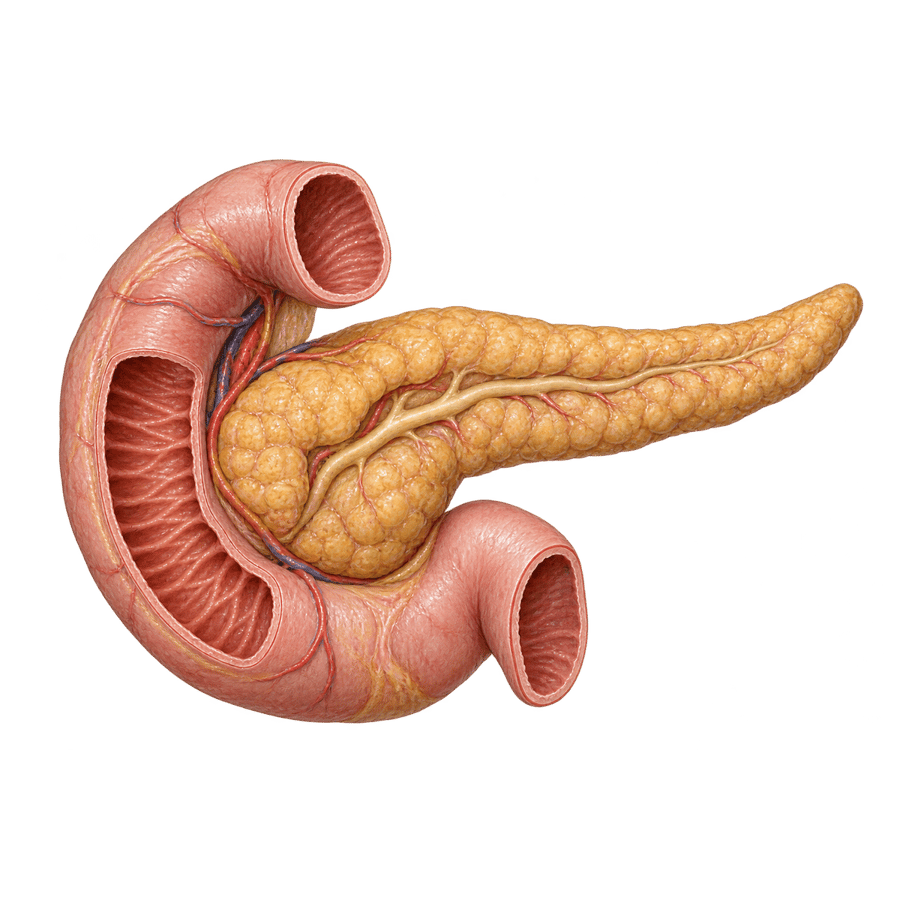
The clearest record comes from Whitehall II, a study of 6,538 British adults followed for a median of 9.7 years. 505 of them developed diabetes, and because they’d had blood tests every few years, researchers could look back at the years before. Insulin sensitivity had fallen steeply over the 5 years before diagnosis. Insulin output rose for a while to cover it, then fell from about 3 years out. Fasting sugar barely moved until those last 3 years, then shot up, from about 104 to 133 mg/dL (5.79 to 7.40 mmol/L).
That makes a fasting glucose a late alarm. By the time it crosses 100, insulin has been losing ground for years. An A1c in the prediabetes range catches some people earlier, and both together catch more.
Which comes first, the muscle or the liver?
Scientists agree on the basic story and argue about where it starts.
The muscle starts it
Muscle takes most of the sugar. Under high insulin in the lab, about 80 to 90% of glucose taken up goes into skeletal muscle.
It goes wrong early. Ralph DeFronzo and Devjit Tripathy argued in 2009 that muscle insulin resistance is the first defect in type 2 diabetes, present decades before the pancreas fails.
The liver starts it
Liver fat moves fast. In a 2011 study, 11 people with type 2 diabetes went on 600 calories a day. Within one week their fasting sugar fell from 9.2 to 5.9 mmol/L (166 to 106 mg/dL), and by week 8 their liver fat had dropped from 12.8% to 2.9%.
The pancreas recovered too. As fat in the liver and pancreas fell, the pancreas’s insulin output returned to normal.
Both sides end up at the same advice. The 600-calorie diet was small and extreme, and nobody should try it without a doctor. What it shows is how quickly the liver can recover when weight comes down.
Can you be insulin resistant at a normal weight?
Yes. Weight is a big risk, but it’s not the only one. In 2012, 18.5% of US adults at a healthy weight had prediabetes, up from 10.2% in 1988 to 1994, and among those 45 and older it was 33.1%. Age, family history, sitting most of the day, short sleep and a history of diabetes in pregnancy all add to it. That’s why the ADA’s standards say everyone should be tested from 35, whatever they weigh. More on whether you have to be overweight.
Does it have symptoms?
Usually not. Prediabetes has no symptoms most of the time, which is why 8 in 10 people with it don’t know. The CDC lists dark patches of skin around the neck, armpits or groin among the signs of type 2 diabetes, and people with insulin resistance sometimes notice them first. If you see that, ask for a fasting glucose and an A1c.
Can you measure insulin resistance itself?
There’s no simple test for it in everyday practice. A fasting insulin test paired with a fasting glucose gives a number called HOMA-IR: glucose in mg/dL times insulin in µIU/mL, divided by 405. A fasting glucose of 95 and an insulin of 10 gives about 2.3. Published cutoffs differ from study to study, and insulin tests from different labs don’t always agree, so there’s no single line that says you’re resistant. The A1c converter works out HOMA-IR for you and prints no cutoff for that reason. The A1c and fasting glucose are the tests with agreed lines.
Why is insulin resistance bad, beyond blood sugar?
Insulin resistance isn’t only the first step toward type 2 diabetes. The US National Institute of Diabetes and Digestive and Kidney Diseases (NIDDK) lists the conditions that travel with it: fatty liver disease, high blood pressure, and unhealthy levels of cholesterol and triglycerides. When several of these show up together, it’s called metabolic syndrome, which the NIDDK says raises your risk for heart disease, diabetes and stroke.
Insulin resistance and prediabetes “usually have no symptoms,” in the NIDDK’s words, which is why they’re found with a lab test, not a feeling.
What travels with it
Fatty liver, high blood pressure, and unhealthy cholesterol and triglycerides. The NIDDK lists them as linked to insulin resistance. Polycystic ovary syndrome and sleep apnea raise the risk of it.
What it raises the risk of
Type 2 diabetes, heart disease and stroke. More than 2 in 5 American adults have prediabetes, and 8 in 10 of them don’t know. See what type 2 diabetes really is.
Blood pressure and cholesterol have their own guides: bloodpressure.guide’s how to lower blood pressure and cholesterol.guide’s triglycerides and HDL.
How do you reverse insulin resistance?
Empty the house and use the bedrooms.
Lose weight if you carry extra. In the Diabetes Prevention Program, weight loss was the main thing that predicted who stayed free of diabetes. Each kilogram lost (2.2 pounds) went with 16% lower risk. The plan, dated to your retest, is on how to reverse prediabetes.
Use your muscles. A contracting muscle pulls sugar in through its own signals, separate from insulin’s, and that route still works in muscle that has become insulin resistant. People in the same trial who missed the weight goal but hit the activity goal still had 44% lower risk. See why moving your muscles lowers it.
Sleep. In 20 healthy men kept to 5 hours in bed for a week, insulin sensitivity fell 11%. One bad week isn’t a disease, but years of short nights push the same way. See sleep and the morning rise.
Eating window, maybe. In a small trial, 8 men with prediabetes ate all their food within 6 hours, finishing before 3 pm, for 5 weeks, with their weight held steady. Their insulin levels fell and their insulin sensitivity improved, though their fasting glucose didn’t change. It’s an interesting result, but it was only 8 people. If you take insulin or a sulfonylurea, don’t change when or how much you eat without your prescriber, since that raises the risk of lows.
Each of these is sized on its own in the habits that cut your type 2 risk. Lifestyle programs cut the relative risk of diabetes by 40 to 70% in people with prediabetes. If you’ve heard that insulin from carbs is what makes you store fat, bodyfat.guide takes that apart in does insulin make you fat.
13 sources
- Tabák AG and others, Trajectories of glycaemia, insulin sensitivity, and insulin secretion before diagnosis of type 2 diabetes (Whitehall II), The Lancet, 2009pubmed.ncbi.nlm.nih.gov
- DeFronzo RA and Tripathy D, Skeletal muscle insulin resistance is the primary defect in type 2 diabetes, Diabetes Care, 2009pmc.ncbi.nlm.nih.gov
- Lim EL and others, Reversal of type 2 diabetes: normalisation of beta cell function in association with decreased pancreas and liver triacylglycerol, Diabetologia, 2011pubmed.ncbi.nlm.nih.gov
- Mainous AG and others, Prevalence of prediabetes and abdominal obesity among healthy-weight adults: 18-year trend, Annals of Family Medicine, 2016annfammed.org
- Hamman RF and others, Effect of weight loss with lifestyle intervention on risk of diabetes, Diabetes Care, 2006pubmed.ncbi.nlm.nih.gov
- Sylow L, Kleinert M, Richter EA and Jensen TE, Exercise-stimulated glucose uptake: regulation and implications for glycaemic control, Nature Reviews Endocrinology, 2017pubmed.ncbi.nlm.nih.gov
- Buxton OM and others, Sleep restriction for 1 week reduces insulin sensitivity in healthy men, Diabetes, 2010pubmed.ncbi.nlm.nih.gov
- Tabák AG and others, Prediabetes: a high-risk state for diabetes development, The Lancet, 2012pubmed.ncbi.nlm.nih.gov
- CDC, Diabetes symptomscdc.gov
- Biernacka-Bartnik A and others, The cut-off value for HOMA-IR discriminating the insulin resistance based on the SHBG level in women with polycystic ovary syndrome, Frontiers in Medicine, 2023pmc.ncbi.nlm.nih.gov
- American Diabetes Association, Standards of Care in Diabetes 2026, section 2, Diagnosis and Classification of Diabetespmc.ncbi.nlm.nih.gov
- National Institute of Diabetes and Digestive and Kidney Diseases, Insulin resistance and prediabetesniddk.nih.gov
- Sutton EF and others, Early time-restricted feeding improves insulin sensitivity, blood pressure, and oxidative stress even without weight loss in men with prediabetes, Cell Metabolism, 2018pmc.ncbi.nlm.nih.gov