Where blood sugar comes from and where it goes
On this page
About 4 grams of sugar, one teaspoon, circulates in all the blood of an average adult. Food tops it up after meals, and your liver tops it up between them. Insulin opens the doors that let it out of the blood, and your muscles take about 80% of what insulin moves. Healthy blood sugar is that flow kept in balance, all day.
What we’d do
Look after the places the sugar goes, more than the sugar itself. Your muscles are the biggest store, so use them. Walk after meals and do some kind of strength work twice a week. Count bread, rice, pasta and potatoes as sugar, because by the time they reach your blood they are. Drop sugary drinks first, since a can of cola puts almost 10 times your blood’s whole sugar supply in front of your body at once.
If you remember three things
- Your blood holds about a teaspoon of sugar. Everything you eat has to be moved out of it and stored.
- Starch is sugar in chains. A cup of white rice has more digestible carbs than a can of cola.
- Muscle is the main sugar store. It takes about 80% of what insulin moves, and a working muscle pulls sugar in on its own.
Is blood sugar bad?
Blood sugar has a bad name it doesn’t deserve. Glucose is fuel. Your brain runs on it, and in a person sitting still before breakfast, the brain uses about 60% of the glucose being burned. With none in your blood, your brain stops working. With too much for years, you get diabetes and the damage that comes with it. The goal is the right amount, held steady, which a healthy body does without you noticing.
The confusion usually runs the other way too. People think blood sugar comes from sugar, the sweet stuff. A lot of it comes from food that tastes salty or plain, and some of it your body makes itself.
How much sugar is in your blood?
About 4 grams in all the blood of a 154 pound (70 kg) person, according to a 2009 review by Vanderbilt physiologist David Wasserman, titled “Four grams of glucose”. That’s one teaspoon. A 12-ounce can of cola has 39 grams, almost 10 teaspoons.
Run those numbers forward and the whole system makes sense. Even at 180 mg/dL, about twice the usual level, the blood would hold only about 8 grams. Your body can’t let a meal’s sugar pile up in the blood. It has to keep moving it into storage almost as fast as it arrives, and in a healthy person that works so well that two hours after the lab’s 75 gram glucose drink, blood sugar is back under 140 mg/dL.
Where does blood sugar come from?
Three places.
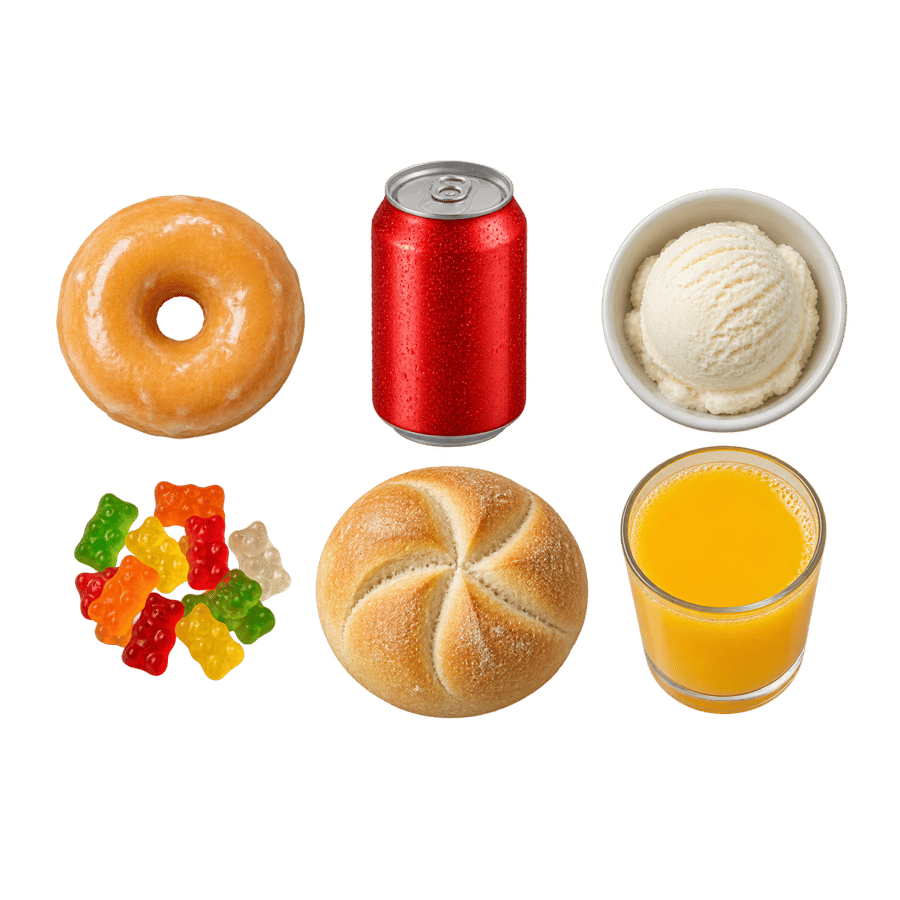
Sugar you eat. Table sugar, honey, fruit sugar and the sugar in drinks all end up as glucose or get turned into it.
Starch you eat. Bread, rice, pasta, potatoes and cereal are starch, and starch is glucose molecules linked in long chains. Your gut cuts the chains apart and the glucose goes into your blood. A cup of cooked white rice has about 45 grams of carbs and 0.6 grams of fiber, so about 44 grams your body digests. That’s more than the 39 grams in the can of cola. How fast the chains come apart depends on the food. Finely milled flour and instant oats come apart fast, and grains you can still see, beans and pasta come apart slower, which is what the glycemic index measures (white bread scores 75, white spaghetti 49, lentils 32).
Your liver. Between meals and overnight, your liver releases glucose from its own store, called glycogen, and it can also make new glucose from the building blocks of protein and fat. That’s why your blood sugar doesn’t crash when you skip breakfast, and why it can rise a little before you wake up. In 8 healthy volunteers studied in 1984, blood sugar and insulin rose after 5:30 in the morning, mostly because the liver was making more glucose.
Where does it go?
Insulin, made in the pancreas, is the signal. When blood sugar rises after a meal, insulin rises with it and does two things at once. It tells the liver to stop releasing sugar, since insulin is the main controller of how much the liver puts out. And it opens doors in muscle and fat cells so sugar can leave the blood.
Muscle is the biggest destination. When researchers hold insulin high in the lab and drip in glucose, about 80% of the glucose taken up goes into skeletal muscle. After a real meal, the liver and gut take a share too, about 30 to 40% of an oral glucose drink. Fat cells take some too.
Working muscle has its own door. When a muscle contracts, it pulls glucose in through signals that are separate from insulin’s, and that route still works in muscle that has become resistant to insulin. It’s why a walk after dinner lowers blood sugar even in people whose insulin works poorly. The movement part covers it.
| Where it goes | What happens there | What fills or empties it |
|---|---|---|
| Brain | Burns it steadily, about 60% of the glucose used at rest before breakfast | Nothing you do changes it much |
| Muscle | Stores it as glycogen and burns it when you move | Moving empties it, and more muscle means more room |
| Liver | Stores it, then releases it between meals and overnight | Hours without food empty it |
| Fat | Takes some sugar after meals, and stores spare energy as fat | Eating more than you burn fills it |
What happens when you exercise hard?
Sometimes blood sugar goes up during exercise, which surprises people with a sensor. In very hard efforts, above about 80% of your maximum, the liver’s sugar output rises 7 to 8 times while the muscles’ use rises 3 to 4 times, so blood sugar climbs. It can climb a little more right as you stop, and then insulin rises for 40 to 60 minutes to bring it back down. That’s normal.
What goes wrong in type 2 diabetes?
The doors get sticky. Muscle, liver and fat answer insulin more slowly, so the pancreas makes more insulin to keep blood sugar normal. For years it manages. In the Whitehall II study of 6,538 British adults, people who later developed diabetes had insulin sensitivity falling steeply for 5 years before diagnosis, while their insulin output rose to cover it and then fell. Their fasting sugar climbed steeply only in the last 3 years.
Type 2 comes from insulin resistance plus a pancreas that eventually can’t keep up, and the insulin is high for years along the way. The full story is in how insulin resistance builds.
How do you see it in your own numbers?
A fasting glucose measures what your liver is doing after a night without food. The 2-hour test after the lab’s glucose drink measures how fast you clear a big dose. An A1c measures sugar stuck to your red blood cells over about 3 months. In the US, fasting under 100 mg/dL, under 140 two hours after the drink and an A1c under 5.7% are normal. What each one means, and when to repeat it, is in your numbers.
10 sources
- Wasserman DH, Four grams of glucose, American Journal of Physiology Endocrinology and Metabolism, 2009pmc.ncbi.nlm.nih.gov
- Harvard T.H. Chan School of Public Health, The Nutrition Source, Added sugar in the dietnutritionsource.hsph.harvard.edu
- DeFronzo RA and Tripathy D, Skeletal muscle insulin resistance is the primary defect in type 2 diabetes, Diabetes Care, 2009pmc.ncbi.nlm.nih.gov
- Atkinson FS, Foster-Powell K and Brand-Miller JC, International tables of glycemic index and glycemic load values 2008, Diabetes Care, 2008pmc.ncbi.nlm.nih.gov
- USDA National Nutrient Database, Rice, white, long-grain, regular, enriched, cooked, via NutritionValue.orgnutritionvalue.org
- Bolli GB and others, Demonstration of a dawn phenomenon in normal human volunteers, Diabetes, 1984pubmed.ncbi.nlm.nih.gov
- Marliss EB and Vranic M, Intense exercise has unique effects on both insulin release and its roles in glucoregulation, Diabetes, 2002pubmed.ncbi.nlm.nih.gov
- Sylow L, Kleinert M, Richter EA and Jensen TE, Exercise-stimulated glucose uptake: regulation and implications for glycaemic control, Nature Reviews Endocrinology, 2017pubmed.ncbi.nlm.nih.gov
- Tabák AG and others, Trajectories of glycaemia, insulin sensitivity, and insulin secretion before diagnosis of type 2 diabetes (Whitehall II), The Lancet, 2009pubmed.ncbi.nlm.nih.gov
- American Diabetes Association, Standards of Care in Diabetes 2026, section 2, Diagnosis and Classification of Diabetespmc.ncbi.nlm.nih.gov