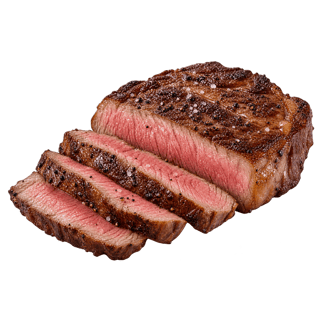
Steak with a baked potato
A baked russet potato tested at a GI of 85 in one US study, close to glucose. The steak beside it carries no carbs at all.
- Digestible carbs
- 46 g
- GI
- 85
- Glycemic load
- 39
- In cans of cola
- 1.8
A US study put a baked russet potato at a GI of 85, one of the highest of any whole food. The steak, butter and sour cream carry almost no carbs.
A sweet potato scores 63 and carries about half the load. Broccoli in its place makes the plate almost flat.
What the hill looks like
Here's the meal next to its swap in our teaching model, drawn for a healthy adult from published averages. Your own curve will differ, but the gap between the two is the point.
- Steak with a baked potato peaks near 116 mg/dL (6.4 mmol/L) at 50 minutes and is 101 at two hours.
- Steak with a sweet potato peaks near 103 mg/dL (5.7 mmol/L) at 50 minutes and is 95 at two hours.
A teaching model built from published averages for a healthy adult, not a prediction for you. People eating the same meal can differ a lot. How the model works
What would flatten it
- Make it smaller. Half the starch is half the load, since the load is carbs times GI.
- Walk for 10 minutes after. In 41 adults with type 2 diabetes, 10-minute walks after each meal made the rise 12% smaller than one daily walk, and 22% smaller after dinner.
- Eat the protein and vegetables first. The same meal with the carbs 10 minutes later lowered the peak by more than 40% in 15 people with prediabetes.
- Swap the drink. Any sweet drink on the side adds its whole load, and water adds none.
Run this meal in the simulator, switch on a walk or carbs last, and watch where the sugar goes.
What the numbers rest on
GI from the food tested on its own.
- Baked potato: 46.2 g digestible carbs from USDA Nutritive Value of Foods, item 1163, p. 82: With skin, 1 potato (202 g). GI 85, Sydney GI database, Russet potatoes, cut into quarters, baked in foil for 1 h at 230oC, peeled (USA 2012).
- Also on the plate, with little or no digestible carbs: steak, butter, sour cream.
This is about blood sugar for people without diabetes. If you take insulin or a sulfonylurea, your targets and meal plan come from your prescriber.
The 100 meals that raise blood sugar most · The 100 that keep it steady
7 sources
- US Department of Agriculture, Agricultural Research Service, Nutritive Value of Foods, Home and Garden Bulletin 72, 2002ars.usda.gov
- Atkinson FS, Foster-Powell K and Brand-Miller JC, International tables of glycemic index and glycemic load values, Diabetes Care, 2008pmc.ncbi.nlm.nih.gov
- University of Sydney, Glycemic Index Research and GI Database, accessed November 15, 2026glycemicindex.com
- Geliebter, A., et al., Satiety following intake of potatoes and other carbohydrate test meals. Annals of Nutrition & Metabolism, 2013. 62(1): p. 37-43, via the University of Sydney GI databaseglycemicindex.com
- Reynolds AN and others, Advice to walk after meals is more effective for lowering postprandial glycaemia in type 2 diabetes than advice that does not specify timing, Diabetologia, 2016pubmed.ncbi.nlm.nih.gov
- Shukla AP and others, The impact of food order on postprandial glycaemic excursions in prediabetes, Diabetes, Obesity and Metabolism, 2019pubmed.ncbi.nlm.nih.gov
- Hutchins KM and others, Continuous glucose monitor overestimates glycemia, American Journal of Clinical Nutrition, 2025pmc.ncbi.nlm.nih.gov