What are the early signs of prediabetes?
Usually there aren’t any. The US National Institute of Diabetes and Digestive and Kidney Diseases says people with insulin resistance and prediabetes “usually have no symptoms.” That’s why 8 in 10 of the 115.2 million American adults with prediabetes don’t know they have it. The early signs that count are your risk factors and a lab number: a fasting glucose of 100 mg/dL (5.6 mmol/L) or more, or an A1c of 5.7% or more.
What we’d do
Don’t wait for a feeling. If you’re 35 or older, or younger with extra weight and one more risk factor, ask for a lab A1c and fasting glucose. Take the eight-tap Could I have prediabetes? quiz first if you want to know how likely it is.
Why people look for symptoms
We’re used to diseases that announce themselves. Prediabetes doesn’t. Your body covers for it for years: in a British study of 6,538 adults, insulin sensitivity fell steeply for 5 years before diabetes was diagnosed, while fasting sugar only climbed steeply in the last 3. During that stretch most people feel completely normal.
Some people with prediabetes do have symptoms like those of diabetes, the NIDDK notes. The CDC lists those as peeing a lot, thirst, hunger, weight loss without trying, tiredness, blurry vision and frequent infections. If you have them, don’t wait for a routine checkup. Call your doctor, since they can mean your blood sugar is already in the diabetes range.
The early signs that count
Your risk factors. The NIDDK lists overweight, obesity or a large waist, not being physically active and a family history of diabetes. The CDC’s risk test adds age, being a man, high blood pressure and, for women, diabetes in a pregnancy. On that test, a score of 5 or more out of 10 counts as high risk.
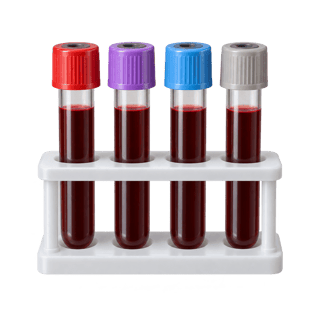
Your numbers. These are the US lines from the American Diabetes Association’s 2026 standards:
- Fasting glucose of 100 to 125 mg/dL (5.6 to 6.9 mmol/L)
- A1c of 5.7 to 6.4% (39 to 47 mmol/mol)
- 140 to 199 mg/dL two hours after the lab’s glucose drink
One result isn’t a diagnosis. A meter at home or a sensor can’t diagnose it either, so take any home number to a lab.
When to get tested
The ADA’s 2026 standards say to test every adult from age 35, and younger adults with a BMI of 25 or more (23 or more with Asian ancestry) plus another risk factor. If the result is normal, test again at least every 3 years. If you had diabetes in a pregnancy, test at least every 1 to 3 years. Once you’re in the prediabetes range, test every year.
If you’d rather test at home, Gyroscope’s home blood test (US and Canada, not New York) includes HbA1c and fasting insulin, and it’s half price with Gyroscope One. A result in the prediabetes range still goes to your doctor and a lab to confirm.
Caught early, it often goes back. More on that in how do I reverse prediabetes? and the whole road in what type 2 diabetes really is.
6 sources
- National Institute of Diabetes and Digestive and Kidney Diseases, Insulin resistance and prediabetesniddk.nih.gov
- CDC, Prediabetes: could it be you? Updated February 17, 2026cdc.gov
- CDC, Diabetes symptomscdc.gov
- American Diabetes Association, Standards of Care in Diabetes 2026, section 2, Diagnosis and Classification of Diabetespmc.ncbi.nlm.nih.gov
- CDC, Prediabetes risk test, how your test is scoredcdc.gov
- Tabák AG and others, Trajectories of glycaemia, insulin sensitivity, and insulin secretion before diagnosis of type 2 diabetes (Whitehall II), The Lancet, 2009pubmed.ncbi.nlm.nih.gov