Is whole wheat bread much better for blood sugar than white?
Short answerNot the way you think
On this page
Not for your blood sugar. On the international glycemic index tables, white bread scores 75 and whole wheat bread 74, close enough to call even. Breads made with whole grains you can still see score much lower, around 53. Pick the grainy loaf, or eat your bread after the rest of the meal.
What we’d do
Choose a loaf with whole grains and seeds you can see, not one that’s just brown. Eat bread with protein and vegetables, and eat it last. Pick whole wheat over white when that’s the choice, though, because a slice has about three times the fiber. Just don’t count on it to shrink the hill. If you want the smallest hill, have less bread and more of the rest of the plate.
If you remember three things
- White and whole wheat bread score 75 and 74. The color barely changes the hill.
- Grains you can see make the difference. Specialty grain bread scores 53.
- When you eat it changes the hill too. Bread eaten last made a much smaller peak.
Why do people think whole wheat is much better?
It looks healthier, it’s sold as healthier, and for some things it is. Brown bread has been the sensible choice in every diet book for decades, so it’s natural to assume it’s gentler on blood sugar too. People with prediabetes often swap white toast for whole wheat and feel they’ve dealt with breakfast.
What decides how fast bread raises blood sugar is how fast your gut can turn its starch into glucose. Color has little to do with that.
What does the glycemic index say?
The glycemic index (GI) ranks foods by how much a fixed amount of their carbs raises blood sugar, with glucose at 100. The 2008 international tables, which pooled studies from around the world, put breads and their cousins here:
| Food | GI |
|---|---|
| White wheat bread | 75 |
| Whole wheat bread | 74 |
| Specialty grain bread | 53 |
| White rice | 73 |
| Brown rice | 68 |
| Instant oat porridge | 79 |
| Rolled oat porridge | 55 |
White and whole wheat sit a single point apart, inside the tables’ margin of error of 2 points either way. Brown rice comes in only 5 points under white. The big gaps come from structure. Rolled oats score 24 points lower than instant oats, though they’re the same grain. Bread with grains you can see scores 22 points lower than plain bread.
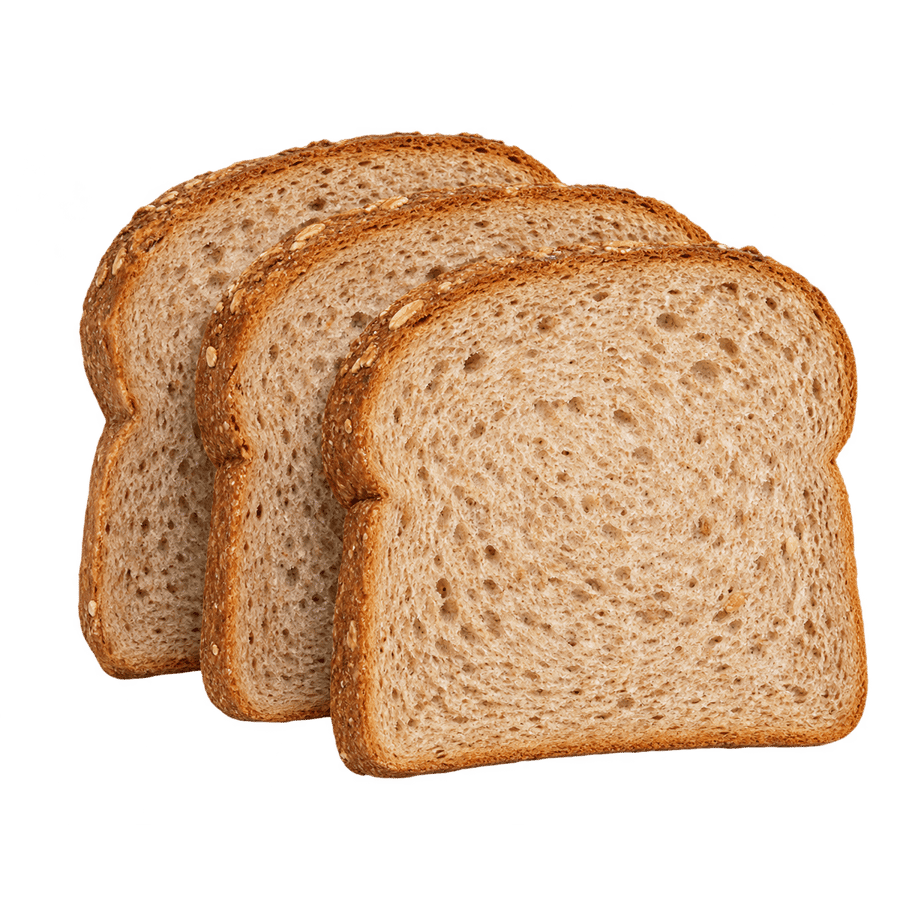
Most whole wheat bread is made from finely ground whole wheat flour. The bran is in there, but it’s ground in with everything else, which likely explains why your gut handles it about as fast. Grains left whole or cracked take longer to break down. It’s like a sugar cube and a spoon of granulated sugar in your coffee. It’s the same sugar, and the finer one dissolves first.
Should you still eat whole wheat?
Yes, for reasons other than the hill. A typical slice of whole wheat bread has about 1.9 grams of fiber, against about 0.6 grams in a slice of white, so roughly three times as much. If you’re choosing between the two, whole wheat is the better slice. It just won’t change your after-meal number much.
Does it matter when you eat the bread?
It makes a big difference. In a 2019 trial, 15 adults with prediabetes ate the same meal of protein, vegetables and carbs three ways on three days. When they ate the protein and vegetables first and the carbs 10 minutes later, the peak was about 46% lower than when they ate the carbs first. Same bread, smaller hill.
A walk after the meal helps too. Ten minutes of walking after each meal made the rise after eating 12% smaller than one 30-minute walk a day, and 22% smaller after dinner.
The best case for whole wheat on blood sugar
Whole wheat helps
It has more fiber. About three times as much per slice.
Some loaves are grainier than others. A whole wheat loaf with cracked grains and seeds can land much closer to the specialty grain number.
The numbers say not much
The standard loaves tie. 74 against 75 is no difference you’d see on a meter.
People differ more than breads do. In a study of 800 people, identical meals gave very different responses from person to person.
That second point cuts both ways. If you wear a sensor, test your own loaves. Eat each one on its own morning, in the same amount with everything else the same, and compare the hills.
Which bread is best for blood sugar?
Look for whole grains and seeds you can see in the slice. Read the label for grams of fiber per slice and pick the higher one. Keep the portion modest, put protein on it or beside it, and eat it after the vegetables. Test yourself on breads, rice and cereal in Which spikes more?, where white and whole wheat bread is round one.
6 sources
- Atkinson FS, Foster-Powell K and Brand-Miller JC, International tables of glycemic index and glycemic load values 2008, Diabetes Care, 2008pmc.ncbi.nlm.nih.gov
- USDA National Nutrient Database, Bread, commercially prepared, whole-wheat, via NutritionValue.orgnutritionvalue.org
- USDA National Nutrient Database, Bread, commercially prepared, white, via NutritionValue.orgnutritionvalue.org
- Shukla AP and others, Carbohydrate-last meal pattern lowers postprandial glucose and insulin excursions in type 2 diabetes and prediabetes, Diabetes, Obesity and Metabolism, 2019pubmed.ncbi.nlm.nih.gov
- Zeevi D and others, Personalized nutrition by prediction of glycemic responses, Cell, 2015pubmed.ncbi.nlm.nih.gov
- Reynolds AN and others, Advice to walk after meals is more effective for lowering postprandial glycaemia in type 2 diabetes than advice that does not specify timing, Diabetologia, 2016pubmed.ncbi.nlm.nih.gov