The Blood Sugar GuideHow to keep your blood sugar steady
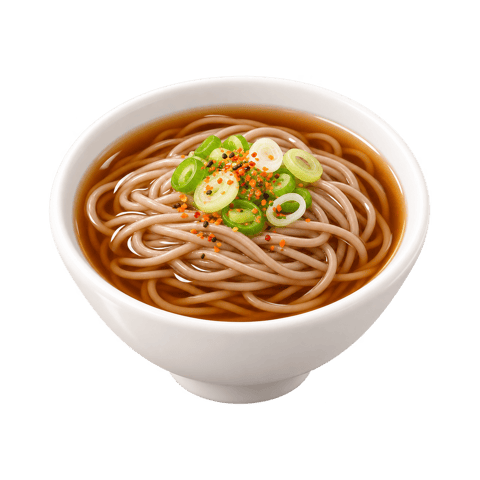
Soba noodles
Rice, pasta and grains

Soba noodles

1 cup cooked has 24 g of carbs. With a GI of 46, that's a glycemic load of 11.

What's in a serving

  • GIout of 100, pure glucose 46
  • Glycemic loadin the serving 11
  • Digestible carbsof 24 g carbs in all 24 g
  • Fiberno figure for this food not listed

A serving is 1 cup cooked (114 g), from the USDA FoodData Central record 168907 (Noodles, japanese, soba, cooked). Digestible carbs are the carbs minus the fiber, the part glycemic load counts. The GI of 46 comes from the University of Sydney's GI database, soba noodles, instant, reheated in hot water, served with soup (Japan 2003).

The hill it makes

Here's a serving in our teaching model, drawn for a healthy adult from published averages, beside a 12 oz can of cola. The height and the length of the hill follow the glycemic load.

140, the 2-hour line fasting, 90 80100120140160180 eat301 h902 h1503 h minutes Soba noodles peak 99 A 12 oz can of cola peak 116
  • Soba noodles peaks near 99 mg/dL (5.5 mmol/L) at 40 minutes and is 92 at two hours.
  • A 12 oz can of cola peaks near 116 mg/dL (6.4 mmol/L) at 29 minutes and is 91 at two hours.

A teaching model built from published averages for a healthy adult, not a prediction for you. People eating the same meal can differ a lot. How the model works

Ways to keep it steady

  • Try a smaller serving.Half as much carries half the load, about 6, since the load is the GI times the carbs you eat.
  • Eat it after your protein and vegetables.In 15 adults with prediabetes, eating the protein and vegetables first, with the carbs 10 minutes later, lowered the peak by more than 40% (Shukla 2019).
  • Have it with chicken, oil and vegetables.In 12 healthy adults, white rice tested at a GI of 96 on its own and 50 when it was eaten with chicken, peanut oil and a leafy vegetable (Sun 2014).
  • Walk for 10 minutes after.In 41 adults with type 2 diabetes, a 10-minute walk after each meal made the rise 12% smaller than one 30-minute walk a day, and 22% smaller after dinner (Reynolds 2016).

Easily log it with a photo in Food XRAY to see how it fits your day's targets.

This is about blood sugar for people without diabetes. If you take insulin or a sulfonylurea, your targets and meal plan come from your prescriber.
7 sources
  1. USDA FoodData Central, Noodles, japanese, soba, cooked, FDC 168907, opened November 17, 2026fdc.nal.usda.gov
  2. Sugiyama, M., et al., Glycemic index of single and mixed meal foods among common Japanese foods with white rice as a reference food. European Journal of Clinical Nutrition, 2003. 57(6): p. 743-752, via the University of Sydney GI database (Sydney GI database, Soba noodles, instant, reheated in hot water, served with soup (Japan 2003))glycemicindex.com
  3. Linus Pauling Institute, Micronutrient Information Center, Glycemic Index and Glycemic Load, Oregon State University, updated March 2016, opened November 16, 2026lpi.oregonstate.edu
  4. Hutchins KM and others, Continuous glucose monitor overestimates glycemia, American Journal of Clinical Nutrition, 2025pmc.ncbi.nlm.nih.gov
  5. Shukla AP and others, The impact of food order on postprandial glycaemic excursions in prediabetes, Diabetes, Obesity and Metabolism, 2019pubmed.ncbi.nlm.nih.gov
  6. Sun L, Ranawana DV, Leow MK and Henry CJ, Effect of chicken, fat and vegetable on glycaemia and insulinaemia to a white rice-based meal in healthy adults, European Journal of Nutrition, 2014pubmed.ncbi.nlm.nih.gov
  7. Reynolds AN and others, Advice to walk after meals is more effective for lowering postprandial glycaemia in type 2 diabetes than advice that does not specify timing, Diabetologia, 2016pubmed.ncbi.nlm.nih.gov
With Gyroscope One, your glucose curve lines up with every meal, walk and night of sleep. Open Gyroscope

Your personalized guide

Get your own blood sugar plan

More than 2 in 5 American adults have prediabetes, and 8 in 10 of them don't know it. Take this simple test to see your risk, which test to get next and the first three things to do.

  • Personalized for you
  • Your risk score and your next test
  • Free, in about two minutes
Start